ATLAS-FWK-07 · Architecture framework
Atlas EDGE
A reusable architecture for translating specialist judgment into grounded, governed, and adaptive intelligence products that can move from idea to production.The challenge
AI ideas often moved toward implementation before teams had defined outcomes, authority, evidence, or acceptance criteria.
Expert knowledge is often implicit, fragmented, and difficult to operationalize. Atlas EDGE creates an architectural path from outcomes and workflows through data, governance, experience design, validation, and accountable delivery.
The approach
Break the decision into evidence, rules, and authority.
- 01
Started with the decision, user, and desired operating outcome.
- 02
Designed data, AI, governance, and experience as connected disciplines.
- 03
Made evaluation, monitoring, and controlled change part of the initial architecture.
Architecture / system
A connected operating system for the decision.
- Target-state architecture, reusable patterns, integrations, and security posture
- Decision rights, ownership, policies, controls, and human oversight
- Grounded data and knowledge with visible source-to-output lineage
- Evaluation scorecards, production runbooks, monitoring, and controlled change
AI design
What the model does
Model behavior is selected only after the workflow, evidence, and risk envelope are explicit.
What remains explicit
Policies, permissions, acceptance criteria, observability, and delivery controls form the stable system boundary.
Where judgment remains
Decision rights identify who reviews, overrides, escalates, and owns downstream outcomes.
Outcome
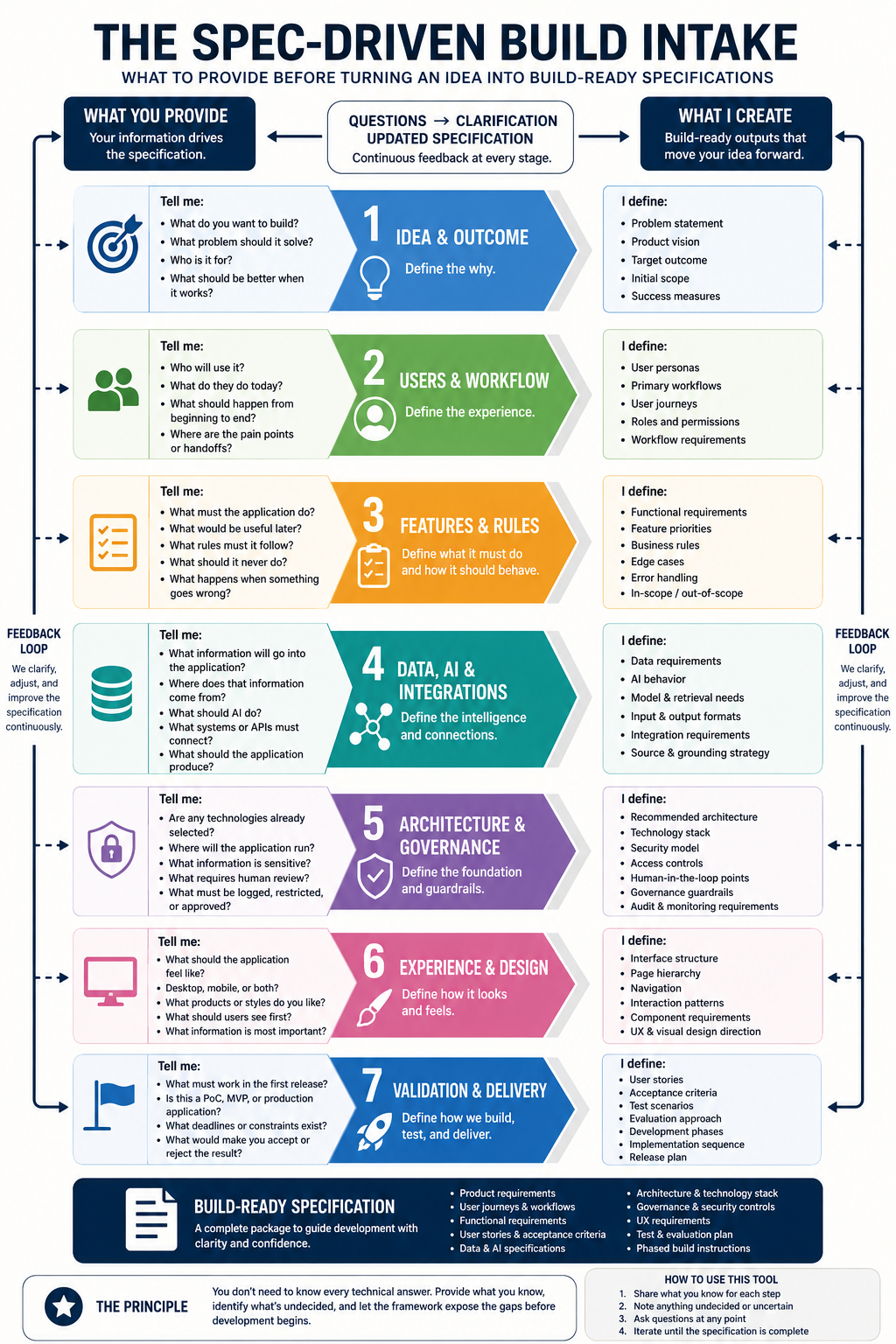
Created a reusable path from an ambiguous AI idea to build-ready specifications, accountable decision rights, evaluation criteria, and controlled production change.
- 7-stage intake framework
- 4 connected design disciplines
- Governance designed into delivery
Architecture in practice:Representative implementation: the Spec-Driven Build Intake Framework turns an idea into build-ready specifications across seven connected stages. Evaluation is designed into the architecture through success measures, acceptance criteria, test scenarios, source grounding, safety and reliability checks, human review, monitoring, and continuous feedback loops.
07 · Lesson / perspective
The best AI architecture begins with accountable decisions and feedback loops, not with a model selection.
Framework resources