ATLAS-RISK-02 · Interactive demo · private local
Risk Intelligence
An enterprise operating-intelligence workspace that connects AI-agent risk, economics, authority, and evidence so leaders can decide what to keep, optimize, restrict, or escalate.The challenge
AI ownership, permissions, spend, and operational risk were difficult to compare as one decision surface.
Enterprise AI agents accumulate fragmented ownership, permissions, model spend, and operational risk. Risk Intelligence creates a decision-ready view of each agent’s operating envelope and the evidence behind recommended changes.
The approach
Break the decision into evidence, rules, and authority.
- 01
Defined each agent as an operating envelope of authority, evidence, cost, and risk.
- 02
Made recommendations comparable through deterministic scoring and counterfactual states.
- 03
Kept production change outside the recommendation layer and behind accountable approval.
Architecture / system
A connected operating system for the decision.
- Deterministic blast-radius, residual-risk, risk-budget, and model-fit analysis
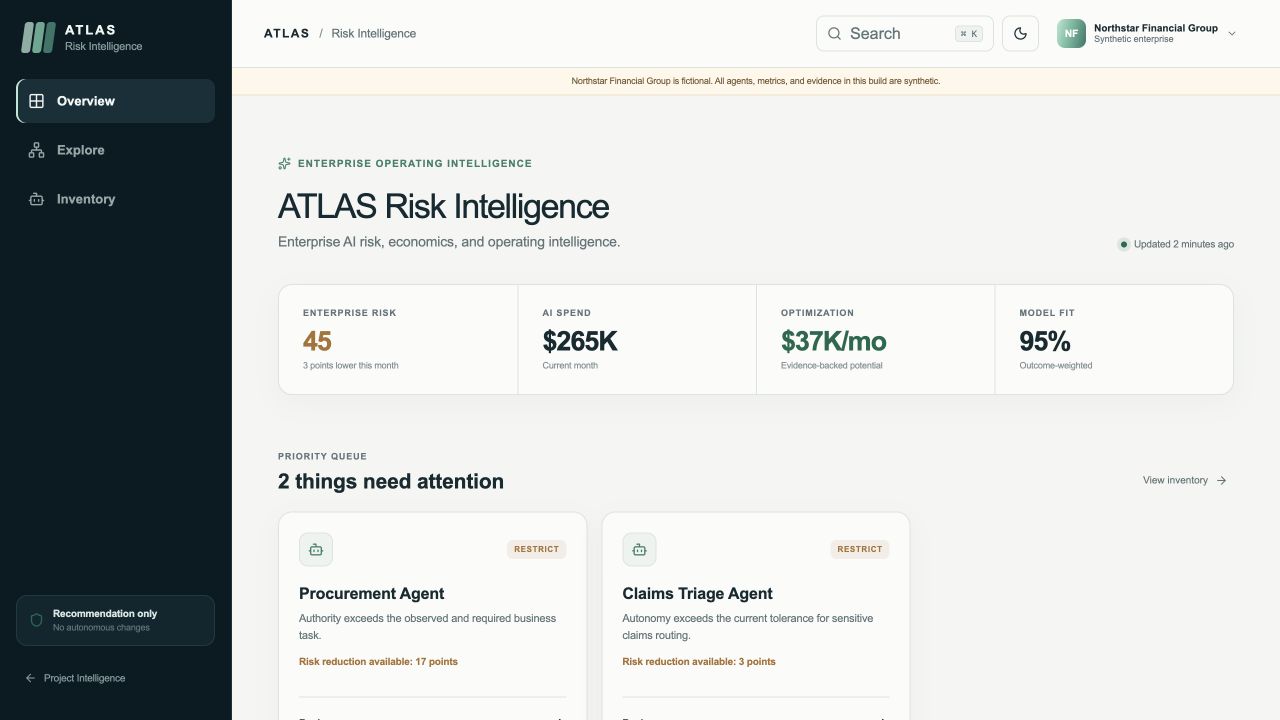
- Agent inventory with ownership, autonomy, permissions, spend, outcomes, and recommendation states
- Enterprise graph connecting agents, models, tools, and sensitive data
- Evidence-backed counterfactual operating envelopes with human approval required for every production change
Product experience
AI design
What the model does
Explains patterns and helps users interrogate evidence behind an operating recommendation.
What remains explicit
Risk budgets, blast radius, residual risk, model fit, and change states are computed through explicit rules.
Where judgment remains
Named owners approve, reject, or modify every production change.
Outcome
Turned fragmented AI ownership, spend, permissions, and risk into a common decision surface for comparing operating envelopes before people authorize change.
- Deterministic risk budgets
- Human approval for every production change
- Agent-to-data lineage
Project facts:Role: product strategy, risk-intelligence architecture, deterministic decision-model design, governance and safety boundaries, and enterprise experience design. The public Northstar workspace is fictional, deterministic, and makes no live AI calls. Recommendations are advisory; humans authorize and execute every production change.
07 · Lesson / perspective
Governance becomes actionable when risk is expressed in the same interface as cost, authority, and operational evidence.