Perspectives

Ideas, frameworks, and working artifacts.

Practical arguments and reusable tools for building AI products with visible evidence, explicit authority, and operational discipline.

Field notes

Short arguments from the operating principles behind the portfolio.
01

Design the risk envelope before the agent

Autonomy should be a bounded operating condition, not a personality trait.

Start by naming what the system may observe, recommend, change, and never touch. Add confidence thresholds, escalation triggers, spend limits, and rollback paths before choosing orchestration patterns. The result is an agent whose authority can be inspected—and narrowed—without relying on good intentions.

Read article →
02

Evidence before eloquence

A persuasive answer is not the same as a decision-ready answer.

High-stakes AI should make its sources, assumptions, gaps, and transformations visible. Grounding is not merely retrieval; it is a chain of accountability from evidence to interpretation to recommendation. If a user cannot challenge the chain, the interface is hiding the most important part of the system.

Read article →
03

Human authority is architecture

Human-in-the-loop only matters when the human has real power.

A review button is theater if the reviewer lacks context, time, or the ability to stop the action. Design explicit decision rights, usable evidence, override paths, and ownership for exceptions. The human role should be specific enough to test, train, and audit.

Read article →
04

Evaluation is the operating system

The learning loop belongs in the product design, not at the end of it.

Define success measures and failure modes alongside the workflow. Capture disagreement, low-confidence cases, overrides, and downstream outcomes. Those signals should shape prompts, retrieval, policy, and product behavior through controlled change—not silent model drift.

Read article →

Resources

Tools you can take into the work.

Architecture field guide · PDF

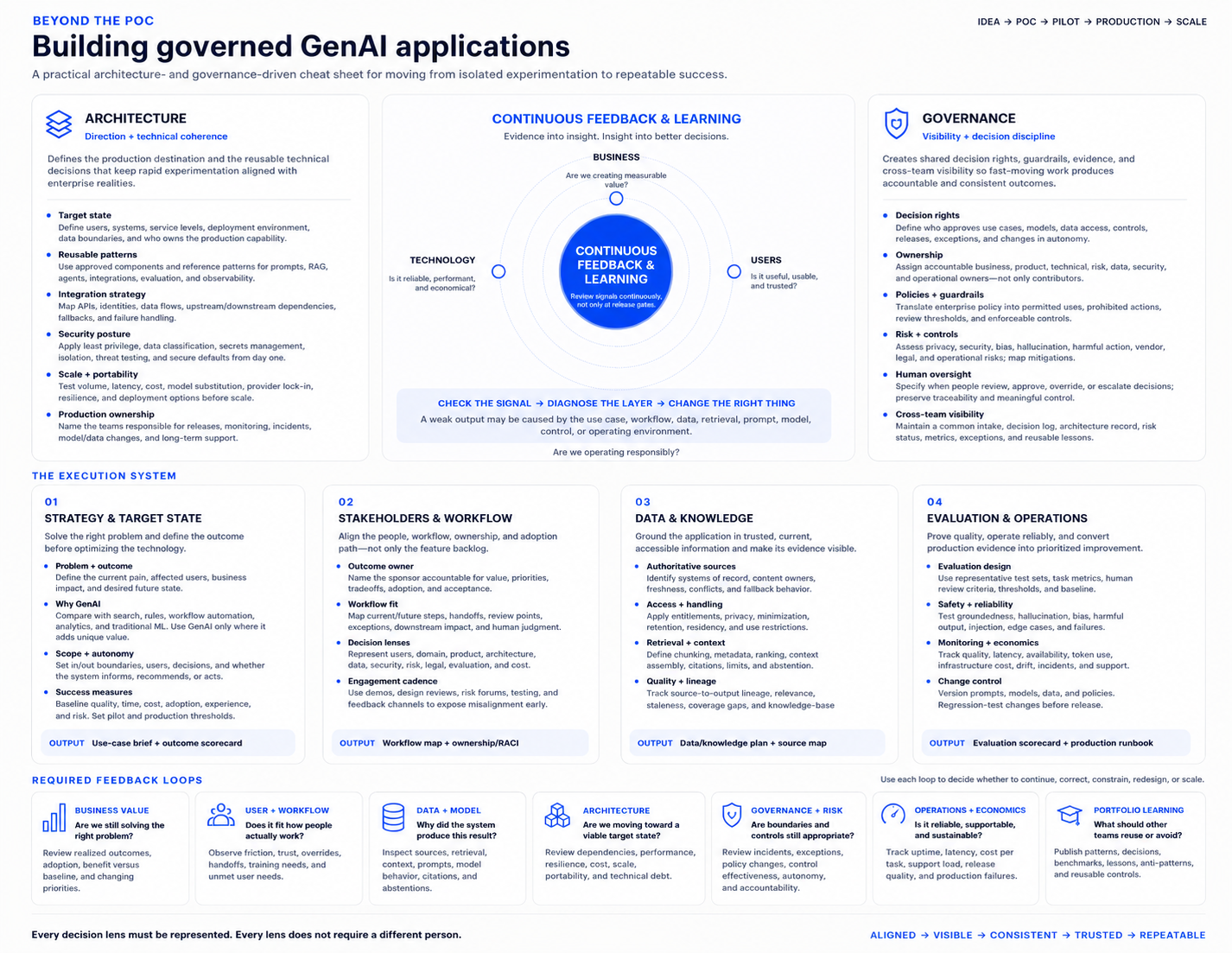
Building Governed GenAI Applications

Production architecture, governance decision rights, execution layers, evaluation operations, and required feedback loops.

Open resource ↗
Framework · PNG

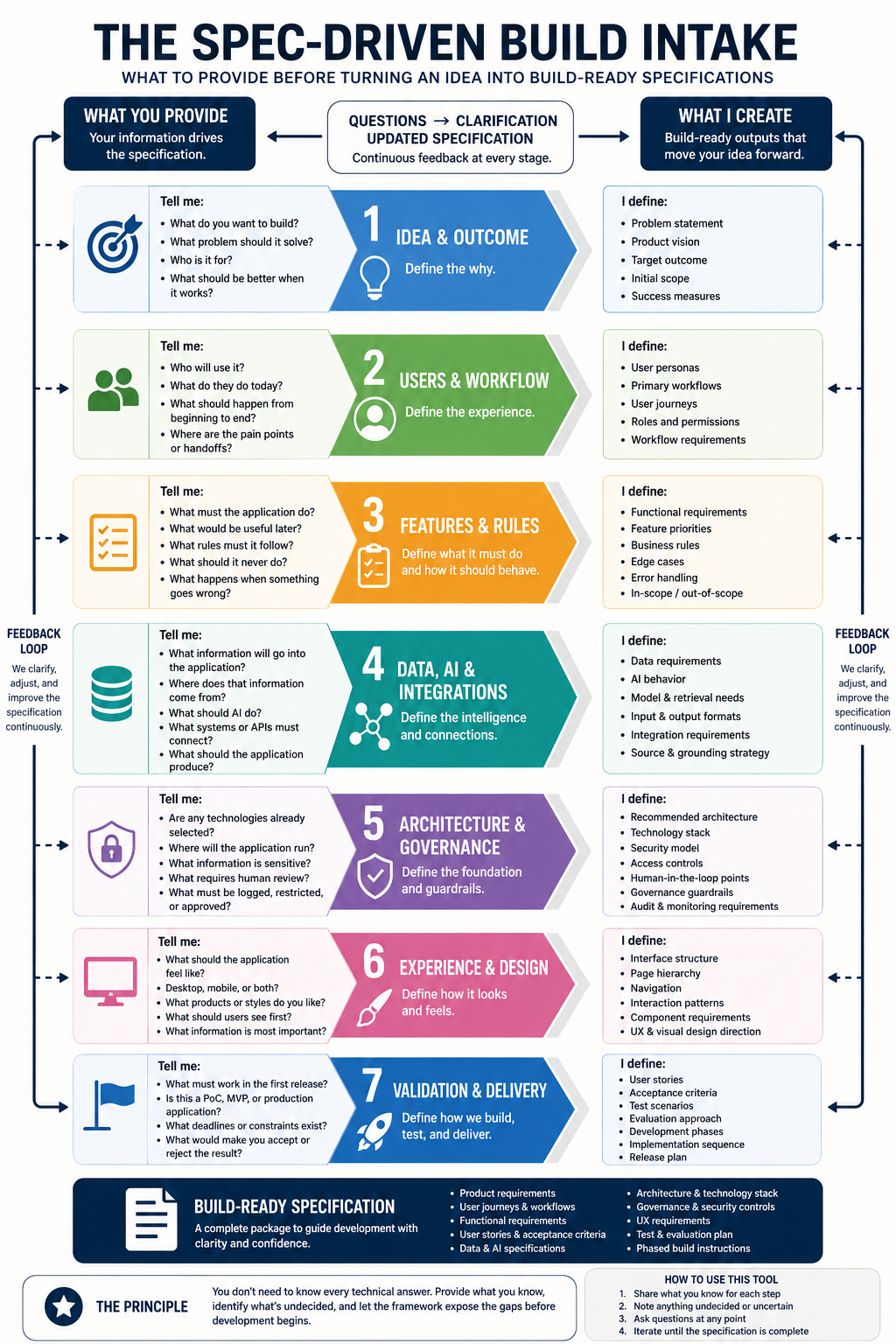
Spec-Driven Build Intake Framework

A seven-stage path from idea and outcome through workflow, rules, integrations, governance, experience, and delivery.

Open resource ↗
Presentation · PDF

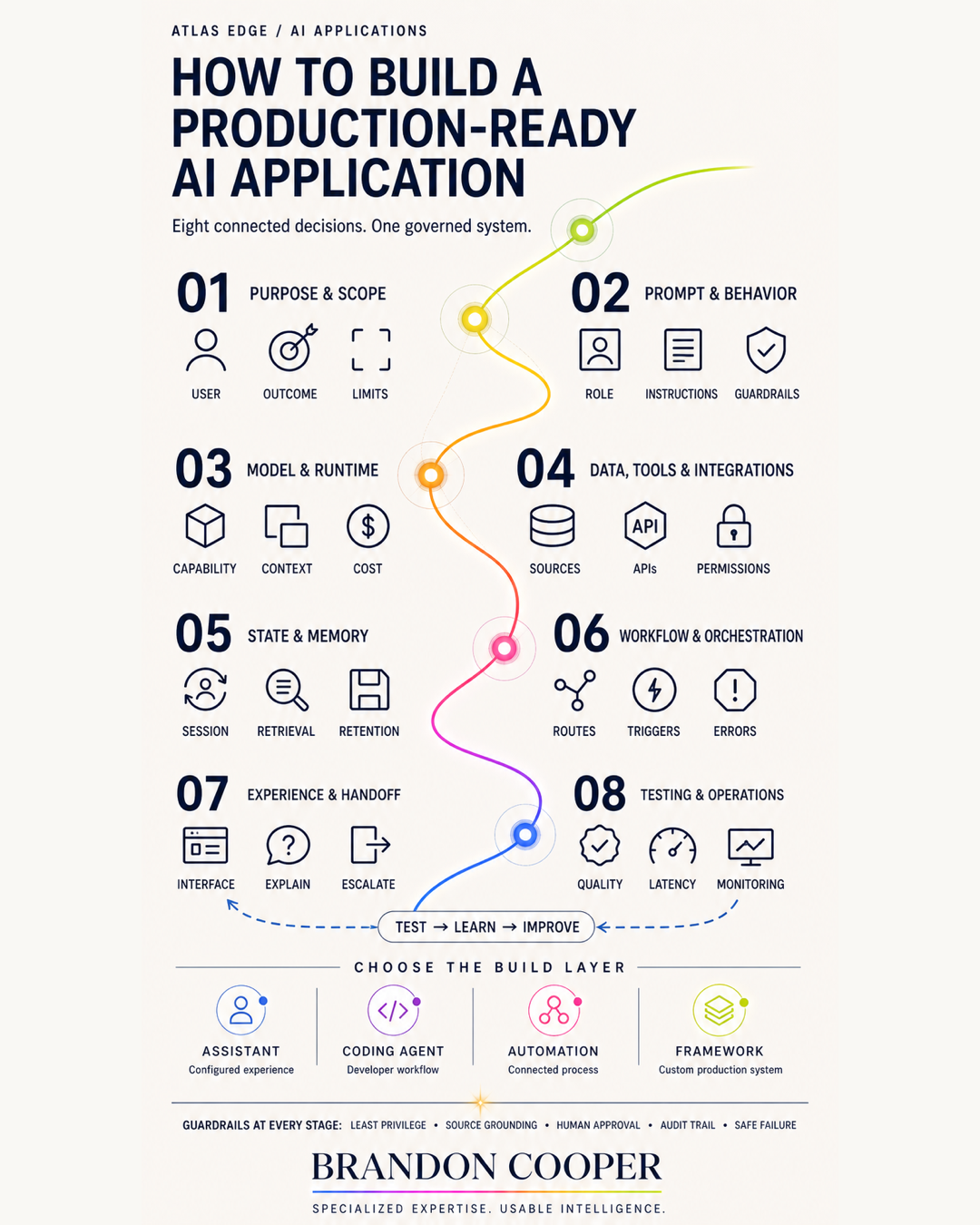
Production-Ready AI Application

A practical visual guide to the layers and controls that turn an AI prototype into an operating product.

Open resource ↗
Checklist · CSV

Production-Readiness Checklist

A portable checklist for evaluating architecture, evidence, governance, experience, and operations.

Open resource ↗